
Single-Use Plastic Pollution through Online Food Delivery (OFD) and a Strategy to Reduce Its Usage
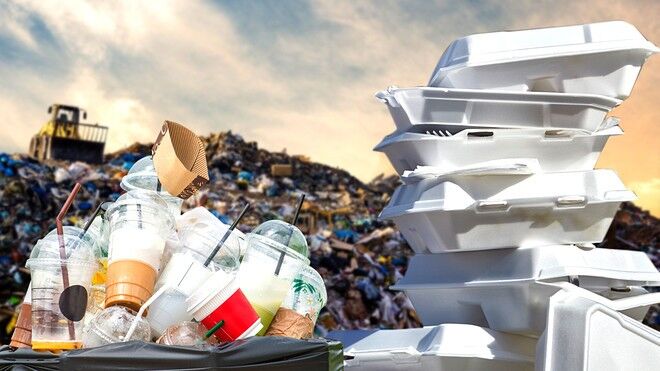
OFD apps have put food a click away and are preferred as they save the hassle associated with cooking. The OFD industry has opened up new opportunities for restaurant owners and consumers by having food delivered to their homes without meeting physically (see Figure 1). On the other hand, its popularity can increase the risk of enormous plastic waste generation because each order often comes with at least 3–4 disposable plastic containers. These plastic consumption habits result in 500 billion single-use plastic (SUP) cups ending up in landfills annually. According to Vasarhelyi, one million SUP plastic bottles or cups are bought every minute, and up to five trillion plastic bags are used globally annually.
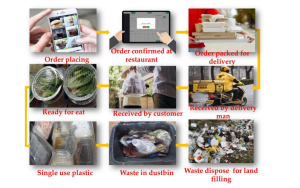
Figure 1. Online food delivery value chain (from placing an order to the final disposal).
In addition, the COVID-19 pandemic promoted an unprecedented change in consumption habits that involved using SUP products. The COVID-19 pandemic boosted worldwide demand for OFD. Beyrouthy reported that grocery and meal delivery segments of the OFD industry earned revenues that were more than double those of pre-pandemic levels. Hu et al. reported that in Japan, the OFD industry increased by 25% from 2016 to 2020, and it is set to increase by a further 17% from 2021 to 2025. South Korea’s OFD industry sales have grown by an average of 85% over the past four years, achieving USD 14.3 billion in sales in 2020. Bush stated that in 2019, Canadians spent CAD 4.7 billion on online food orders, and is estimated will be worth over CAD 98 billion by 2027. Lin et al. reported that during the COVID-19 pandemic, the OFD industry in China experienced 20% annual growth, leading to revenue growth from USD 3.2 billion in 2015 to USD 51.5 billion in 2020. Nowadays, China has the world’s most prominent takeaway food market, and its scale is more than a quarter of China’s catering industry. However the OFD industries in Bangkok, Pakistan, Brazil, India, Indonesia, New Zealand, South Africa, Saudi Arabia, the United Arab Emirates, Bahrain, Kuwait, Qatar, Bangladesh, Vietnam, Turkey, Spain, and Russia saw significant popularity during the COVID-19 period. Additionally, these figures indicate a substantial potential for future growth in the OFD industry. However, this fast-growing trend does not show that although the sector is improving, its effects on society, agriculture, and climate are not very optimistic. This behavior will significantly increase the burden on waste disposal, generating significant waste that litters cities, chokes rivers, causes soil pollution, and threatens wildlife.
The OFD industry has witnessed massive growth in the last few years, and ordering a meal is a convenient option but its impacts on our ecosystem are unsuitable. Janairo and Sha reported that OFD services are a significant burden against the United Nation’s developed sustainable goals that address good health, climate action, decent work, and economic growth. This study further stated that high volumes of OFD consumption exacerbate plastic waste and increase the contamination of natural environments such as oceans, freshwater systems, and terrestrial areas. A study on the environmental impacts of takeout food containers revealed that SUP products are the worst packaging material for takeout food, with many adverse effects on the environment. Plastic containers made from polypropylene and polystyrene foam accounted for approximately 75% of the total food delivery packaging waste by weight. Additionally, each OFD order generated an equivalent of 111.80 g of CO2 emission on average. Most (86%) of the CO2 equivalent of the express food delivery came from the SUP food packages. However, the UN environment program report mentioned that approximately 36% of all SUPs produced are used for packaging food and beverages. The GHG emissions associated with making, using, and disposing of conventional fossil fuel-based plastics are forecast to grow by 19% of the global carbon budget by 2040.
Their significant usage and disposal have become a global concern, and the overutilization has pushed governments to implement a mix of policy measures or ban single-use plastic products. However, after being used, the items are disposed of in waste dumping sites and landfills, where they may end up in rivers, oceans, soil, and the atmosphere.
SUPs have created many environmental issues, and there are also various upstream consequences of a consumption-oriented society that will not be removed even if plastic waste is significantly decreased. The Competitive Enterprise Institute reported that studies have shown that the vast majority of plastic waste is due to poor global disposal practices. Therefore, to some extent, disposable plastic can be removed from the environment through proper recovery and recycling. Putting plastic trash in its correct context is the first step toward better scientific communication about its environmental impact. Furthermore, to assist the public in making linkages between product consumption, energy use, and upstream environmental implications, scientific communication needs to go beyond the “Reduce, Reuse, and Recycle” mantra.
Martin stated that both governments and consumer bodies should put pressure on manufacturing industries to adopt sustainable manufacturing practices to reduce emission levels as fossil fuels are depleted and global warming increases. Customers can also do their part by refusing SUP packaging and opting for reusable alternatives whenever possible. Kocha ´nska et al. stated that bioplastics could be the best alternative material for packing takeaway food. Bioplastics can be produced using food waste, a significant stimulus for transformations in producing petroleum-derived plastics.
2026 january
Ref: Liu, Q., Chen, Z., Chen, Y., Yang, F., Yao, W., & Xie, Y. (2021). Microplastics and nanoplastics: emerging contaminants in food. Journal of Agricultural and Food Chemistry, 69(36), 10450-10468.
This post is also available in: Persian


Leave a Reply
Want to join the discussion?Feel free to contribute!